
The LAC Climate Edge
A report on why, where, and how to support climate and nature tech in Latin America and the Caribbean (LAC).
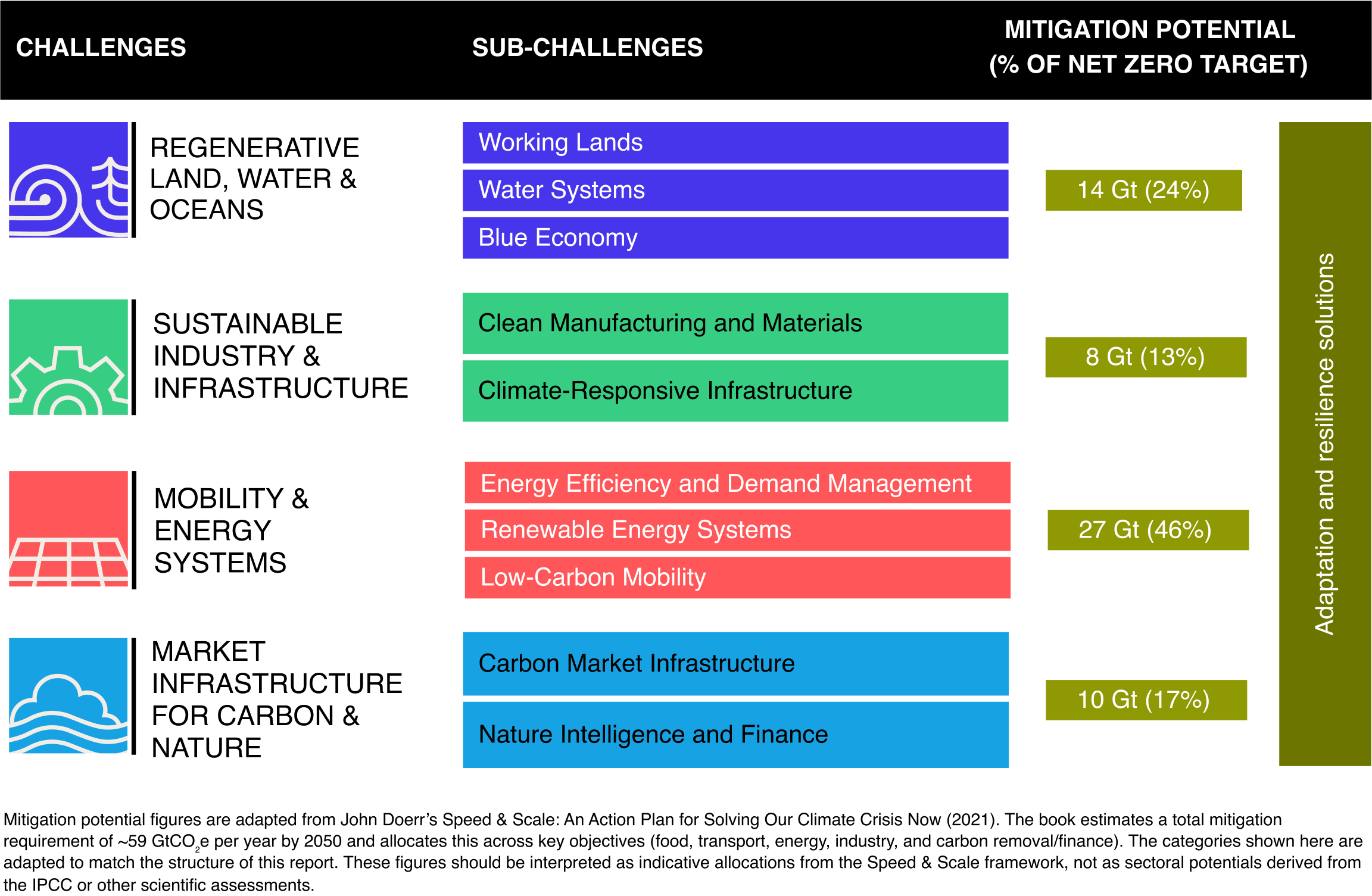
Powered by Reciprocal and supported by Breakthrough Energy Discovery, the report maps existing innovation, investment opportunities, and what it will take to unlock LAC’s full potential as a launchpad for climate solutions the world needs. The report was created by analyzing a proprietary database of over 770 start-ups, conducting rigorous market research, and gathering insights from 110+ collaborators ranging from founders, funders, corporate leaders, policymakers, academics, and accelerator representatives. Our findings are structured around a taxonomy of four sectors, together driving a set of 25 investment theses with multi-billion-dollar market opportunities by 2030.
LAC has an advantage hiding in plain sight. Despite capital and support constraints, regional entrepreneurs are showing ingenuity and tenacity to build solutions. With the right nudge, this can be accelerated and scaled
“Latin America and the Caribbean is one of the world’s great untapped climate innovation frontiers. Founders here live the daily realities of climate change and are creating technology solutions with the potential to scale globally.”
—Ashley Grosh, Vice President of Breakthrough Energy Discovery

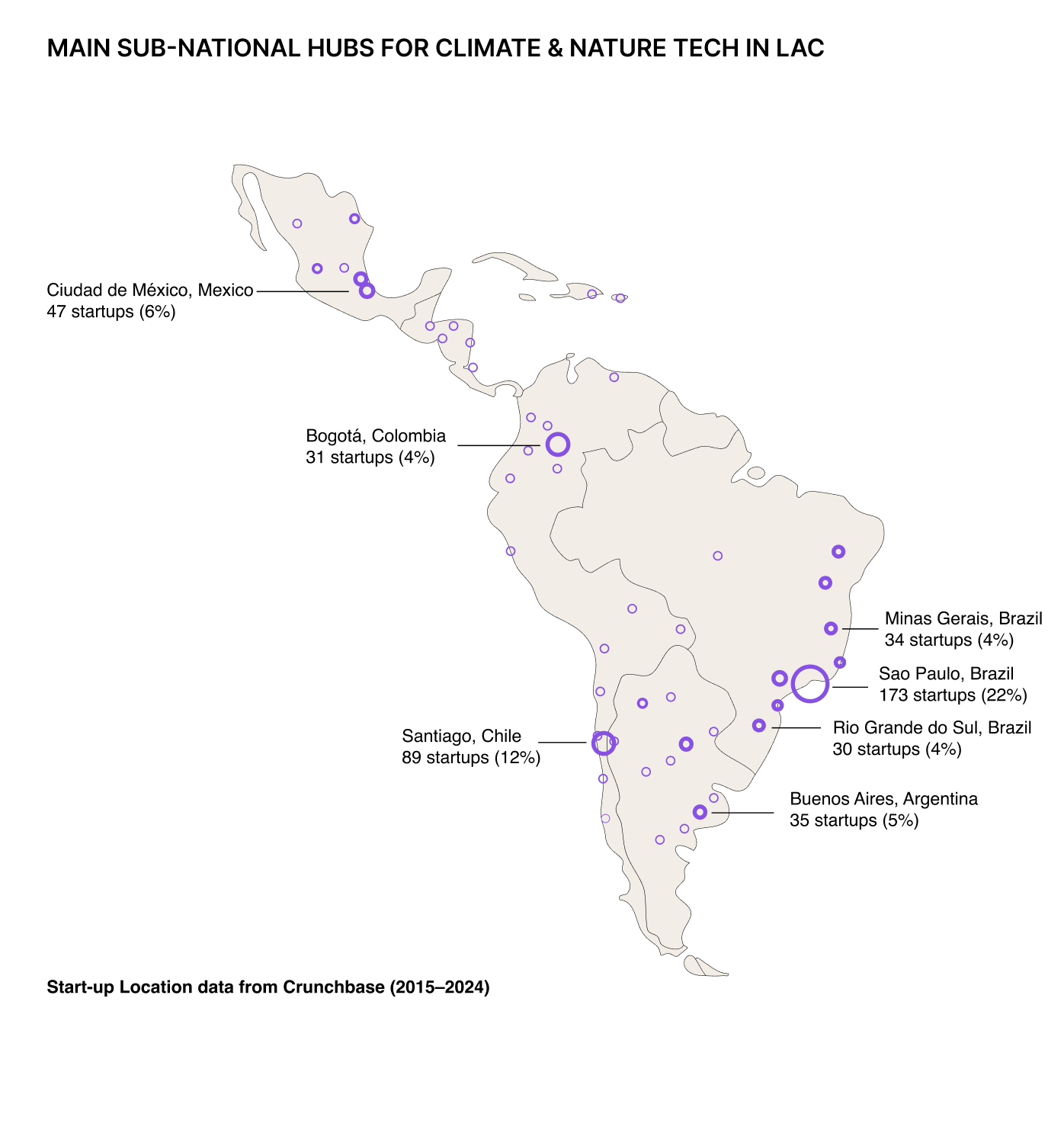
Our landscape analysis found that five markets captured 92% of deals, and countries who invested in their ecosystem saw outsized activity.
Our landscape analysis identified 772 nature & climate tech start-ups headquartered in LAC. As of early 2025, these start-ups had collectively raised $4.3 billion. We estimate the current total value of the regional nature & climate tech ecosystem at $20-24 billion.
Brazil, Chile, Mexico, Argentina and Colombia concentrate 92% of funded nature & climate tech start-ups in LAC.
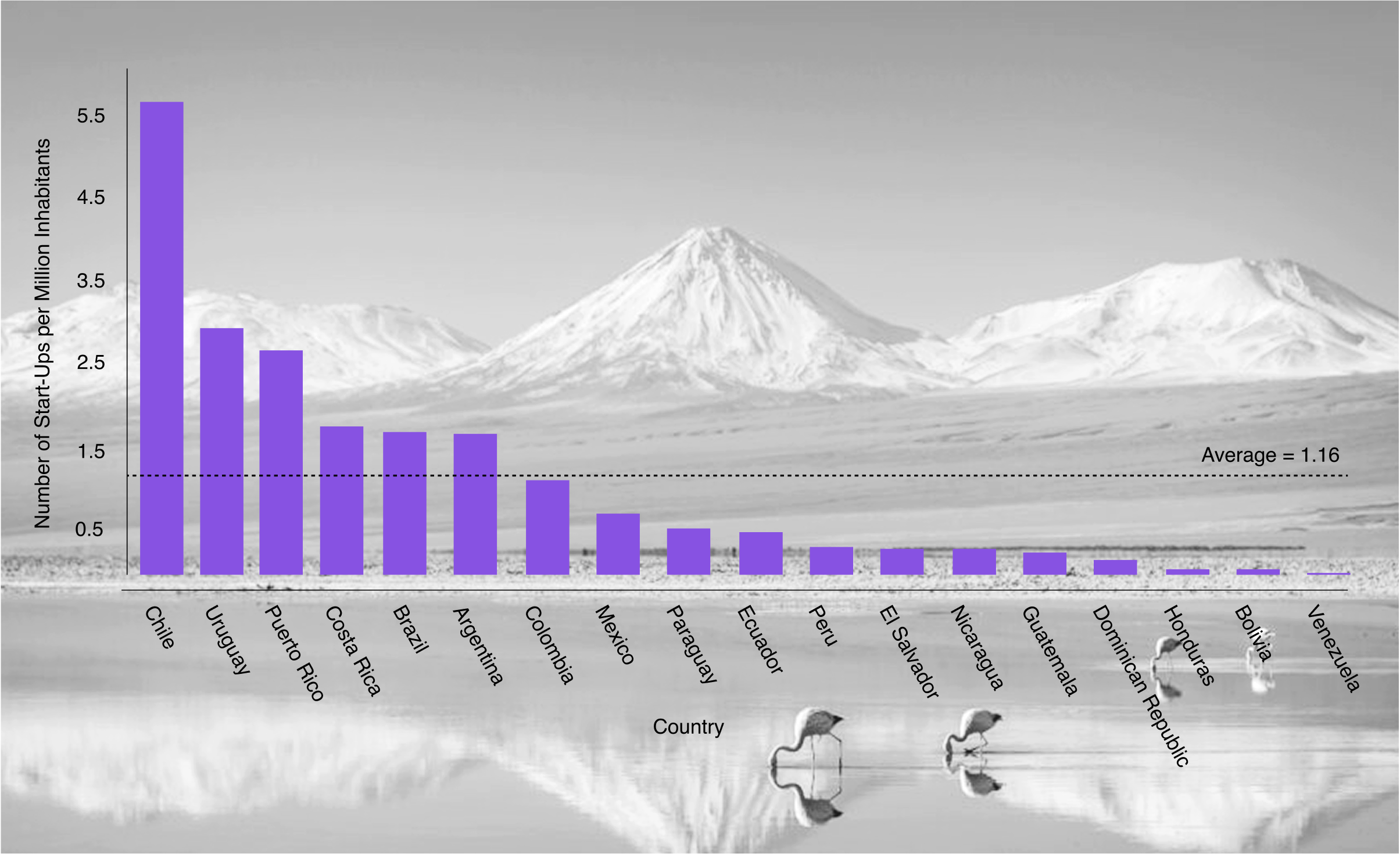
Strong Ecosystems Outperform
Raw numbers alone don’t tell the full story. When adjusted for population, Chile leads the region with approximately 5.64 startups per million people — more than five times the regional average of 1.16. Uruguay, Puerto Rico and Costa Rica also stand out as leaders on a per-capita basis, outperforming larger economies through targeted support for early-stage innovation.
TECHNOLOGY & INNOVATION
Startups across LAC are building climate-smart tech on top of robust infrastructure. 65% of the region’s electricity comes from renewables and countries like Brazil, Chile, and Uruguay are on par with India and NZ in AI readiness. This is coupled with a startup ecosystem that has produced more unicorns than Israel, France, and Germany.
TALENT & DIGITAL READINESS
LAC’s young, digital-native population is driving bold climate solutions. With a 5–10x R&D talent cost advantage over the Global North, it’s a smart, efficient hub for entrepreneurs and builders.

NATURAL CAPITAL & FRONTLINES ADVANTAGE
LAC holds the keys to the planet’s future: home to 40% of global biodiversity, 57% of remaining primary forests and reserves for over a third of the copper and lithium needed for the energy transition. These ecosystems are vital—and invaluable. Moreover, with direct proximity to the world’s toughest climate challenges, the region is uniquely positioned to solve them.

MARKET MATURITY
In 2023, 41% of Latin America’s population was middle class—up from less than 24% in 2005—showing two decades of upward mobility alongside Internet penetration of 74.6%, one of the highest among emerging regions. With 82% of people living in cities, the region is also a global leader in urbanization, creating dense markets for low-carbon mobility, while nearshoring trends position LAC to capture climate-aligned manufacturing and supply chains.
“Startups here get much further with a tenth of the capital.”
— CARLOS DOMÍNGUEZ RULLÁN, CARBONO3

“Latin Americans operate in scarcity, not abundance. That makes us resilient, innovative, and solution-oriented.”
— GERMAN LOSADA, VEMO

“In Latin America, the problems are not abstract — droughts, crop failures, biodiversity loss. Founders feel the problems. That’s why the solutions are bottom-up and adaptive.”
— NAZREEN SHIVLANI, FUNDACIÓN CHILE

“In terms of preparation and human talent in the areas where we invest, I don’t see much difference between someone trained in Chile and someone trained in San Francisco or Oslo. At the science level, we see talent in LAC that is comparable to what exists in other parts of the world.”
— MAXIME FREYSS, FUND MANAGER, SÜDLICH CAPITAL

 Regenerative Land, Water & Oceans
 Mobility & Energy Systems
 Sustainable Industry & Infrastructure
 Market Infrastructure for Carbon & Nature
Within each sector, we explore specific sub-challenges and investment opportunities, supported by sectoral startup maps that reveal a sampling of the companies already building solutions across these domains. In total, we put forward 25 unique opportunities for technologists, investors, founders, and government to leverage the Climate Edge of the region.
Acces the Full Report
Your information will be saved to our records and you’ll get access to the LAC Climate Edge Report.

Copyright © 2026. This work is licensed under a Creative Commons BY-NC-ND 4.0 International License.